Counter
Contact Us!  If your looking for a kit, want to sell off part of your collection or want to place an order please send us
an email to engco45@yahoo.com.  The original contact form that was below has been removed due to some
technical issues.
Welcome to Fire House Hobbies!
Below are links to some of our partners.  If we can't find the kit they might.

www.rareplanedetective.com
What's NEW!   Well the kits below are new for us anyway.  Take and look and see if there is something that you want or need for that
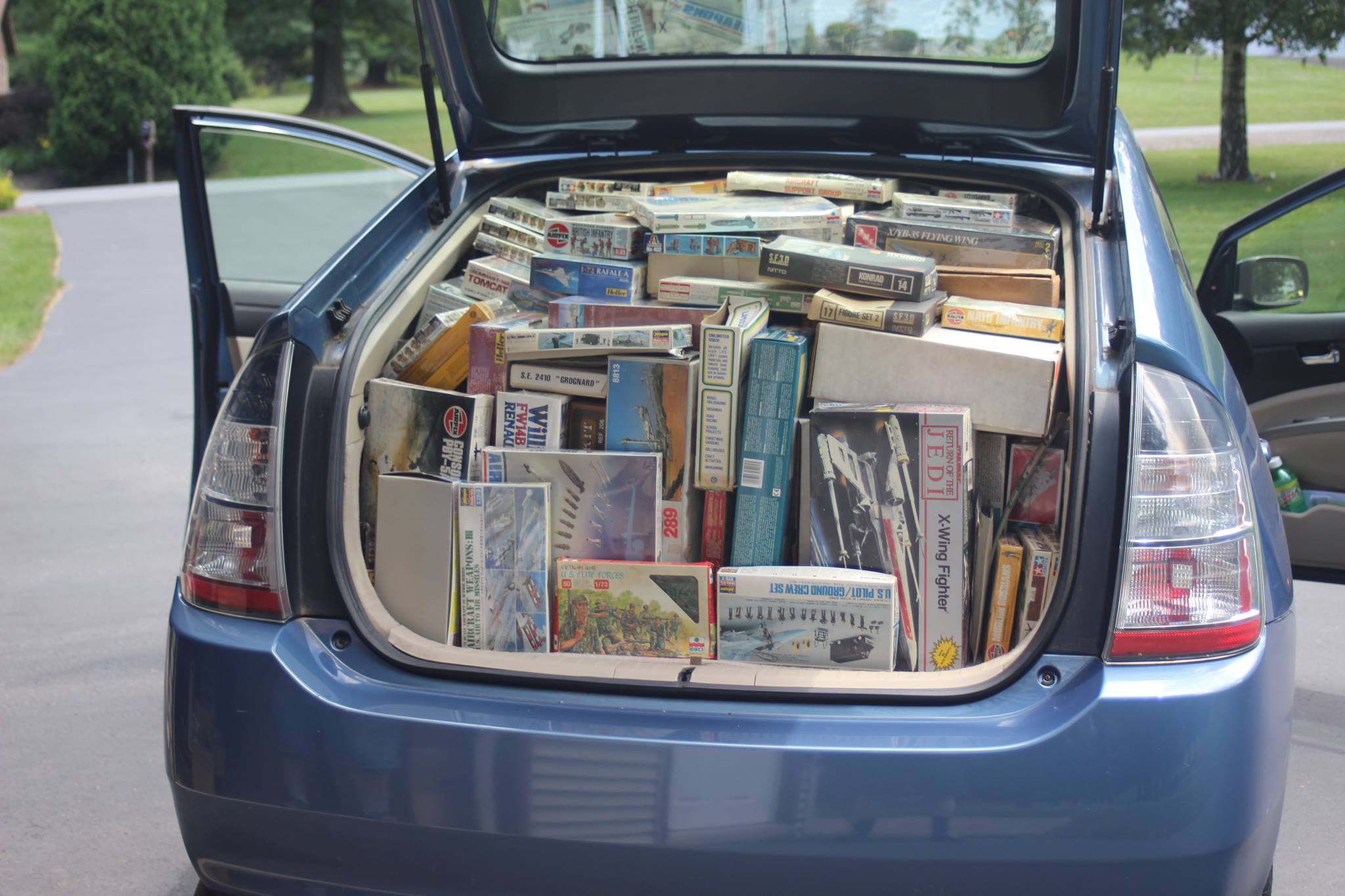
collection of yours!  We've obtained a collection of kits that should be considered old but actually seem like they are almost brand
new.  With the exception of a few dents and dings they are in their original shrink wrap.  So take a look and see if there is something
missing from your collection
.  

We're also  working on obtaining some of the new releases but it doesn't always work out the way.  But if there is a new kit that you
need or want please let us know and well do our best to obtain it.  And of course we are always looking for collections, so if you have
a collection that you wish to sell please contact us at engco45@yahoo.com
Long-serving Lockheed-built Shooting Star 2-seat jet trainer aircraft developed from
the P/F-80 fighter. Often referred to as the 'T-bird', it remains one of the world's best
known aircraft, having served with the air forces of more than 20 countries over a
service life spanning nearly 40 years. Limited-run kit featuring injection-molded
airframe with fine engraved panel lines, multi-part canopy and detailed tandem
cockpits. Also includes resin parts (including ejection seats, cockpit details and
wheels) plus photo-etch parts. Decals for 3 aircraft:

Czech Model kit #3203
Price: $45.00
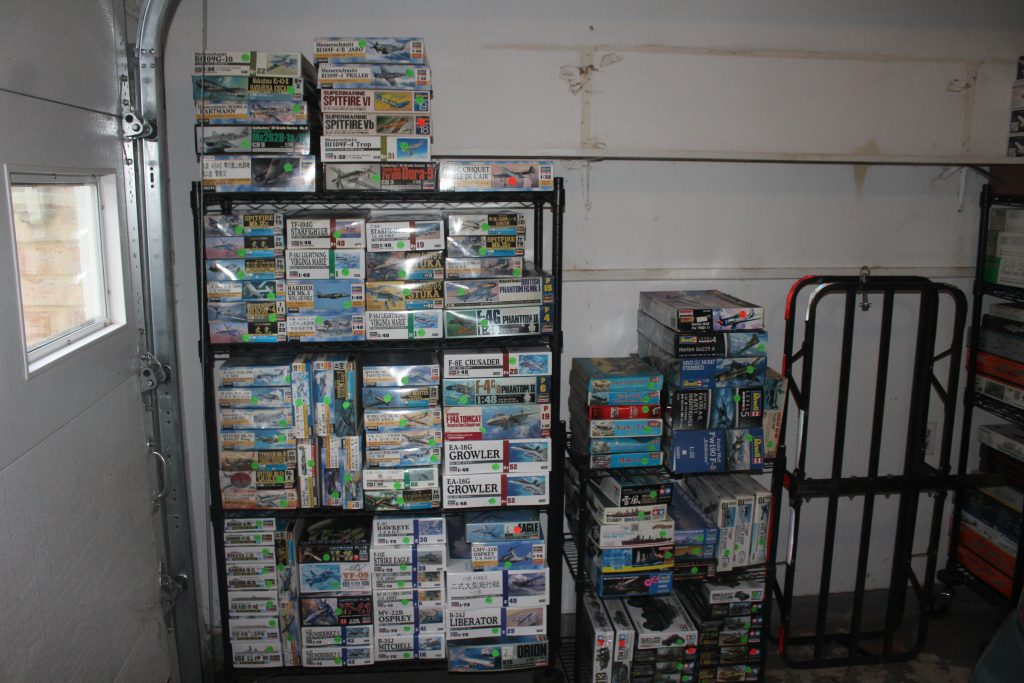
We survived an Earthquake, a hurricane and suprisingly the three day deluge that hit the Washington DC area.  And while the
local news showed pictures of Upper Marlboro Maryland partially underwater the mini-warehouse survived all three events
without a scratch.  The heavy rains we received in the area really suprised us since the news really didn't hype the weather this
time around as they did with the hurricane.  The most damaged occured at home this past week when we arrived home only to
discover that the downstairs bathroom was starting to flood as trickles of water came in the below grade window.  While
cleaning up multiple times Wednesday evening and early Thursday morning we also discovered that water had entered the
garage where some of the kits were being stored.  Luckily only a few empty boxes got wet but it was a bit chaotic moving things
around to keep the kits and other asundry model items dry.  This weekend looks promising where no rain is predicted so we
hope that the forecast is correct so we as well as many residents of the Washington DC area can dry out.      
What's Old is Suddenly New!
The North American B-25 Mitchell was an American twin-engined medium bomber
manufactured by North American Aviation. It was used by many Allied air forces, in
every theater of World War II, as well as many other air forces after the war ended,
and saw service across four decades.

The B-25 was named in honor of General Billy Mitchell, a pioneer of U.S. military
aviation. By the end of its production, nearly 10,000 B-25s in numerous models had
been built. These included a few limited variations, such as the United States Navy's
and Marine Corps' PBJ-1 patrol bomber and the United States Army Air Forces' F-10
photo reconnaissance aircraft.

Monogram kit #5500
Price: $25.00
The Douglas A-26 Invader (B-26 between 1948–1965) was a United States twin-
engined light attack bomber built by the Douglas Aircraft Co. during World War II that
also saw service during several of the Cold War's major conflicts. A limited number
of highly modified aircraft (designation A-26 restored) served in combat until 1969.

The redesignation of the type from A-26 to B-26 has led to popular confusion with the
Martin B-26. Although both types used the R-2800 engine, they are completely
different designs.  The last A-26 in active US service was assigned to the Air National
Guard; that aircraft was retired from military service in 1972 by the US Air Force and
the National Guard and donated to the National Air and Space Museum.

Monogram kit #5506
Price: $18.00
The Heinkel He 111 was a German aircraft designed by Siegfried and Walter Günter
in the early 1930s in violation of the Treaty of Versailles. Often described as a "Wolf
in sheep's clothing", it masqueraded as a transport aircraft, but its purpose was to
provide the Luftwaffe with a fast medium bomber.

Perhaps the best-recognised German bomber due to the distinctive, extensively
glazed, bullet-shaped "greenhouse" nose of later versions, the Heinkel was the
most numerous and the primary Luftwaffe bomber during the early stages of World
War II. It fared well until the Battle of Britain, when its weak defensive armament,
relatively low speed, and poor manoeuvrability were exposed

Monogram kit number:  5509
Price: $22.00  
The final version of the Mitchell, the B-25J, looked much like the earlier B, C and D,
having reverted to the longer nose. The less-than-successful 75 mm (2.95 in) cannon
was deleted on the J model. Instead, 800 of this version were built with a solid nose
containing eight .50  (12.7 mm) machine guns, while other J-models featured the
earlier "greenhouse" style nose containing the bombardier's position. Regardless of
the nose style used, all J-models also included two .50 in (12.7 mm) guns in a
"fuselage package" located directly under the pilot's station, and two more such
guns in an identical package just under the co-pilot's compartment. The solid-nose
B-25J variant carried an impressive total of 18 .50 in (12.7 mm) guns: eight in the
nose, four in under-cockpit packages, two in an upper turret, two in the waist, and a
pair in the tail. No other bomber of World War II carried as many guns.

Monogram kit #5507
Price: $15.00
The Mk VIII (and VII) featured a strengthened fuselage with a retractable tail wheel.
Each wing carried a 14-gallon self sealing fuel tank, and the main fuselage fuel tank
was increased in size to 96 gallons. These changes gave the Mk VIII the same range
as the Mk V, although as this distance was achieved at a higher speed, the Mk VIII
could stay in the air for less time than the Mk V. Most Mk VIIIs used a new broad-
chord, or pointed-tip rudder. It also featured a new tropical filter that was so well
designed it was installed on all Mk VIIIs and adapted for time Mk IX. The Mk VIII used
the “c” wing armament (four cannon or two cannon and two machine guns) and could
carry up to 1,000lbs of bombs.  A Mk VIII was the first Spitfire to use the revised
cockpit seen on most later models, with a cut-down rear fuselage and a bubble
canopy. This design improved the rearwards visibility of the aircraft, and was used in
late production.  

AMT Ertl kit #8881
Price: $10.00
The Focke-Wulf Fw 190 Würger (Shrike) was a German Second World War
single-seat, single-engine fighter aircraft designed by Kurt Tank in the late 1930s.
Powered by a radial engine, the 190 had ample power and was able to lift larger loads
than its well-known counterpart, the Messerschmitt Bf 109. The 190 was used by the
Luftwaffe in a wide variety of roles, including day fighter, fighter-bomber,
ground-attack aircraft also operating to a lesser degree as a night fighter.

When the Fw 190 started flying operationally over France in August 1941, it quickly
proved itself to be superior in all but turn radius to the Royal Air Force's main
front-line fighter, the Spitfire Mk. V.[1] The 190 wrested air superiority away from the
RAF until the introduction of the vastly improved Spitfire Mk. IX in July 1942

AMT Ertl kit #8887
Price: $8.00
The Douglas A-20/DB-7 Havoc was a family of American attack, light bomber and night
fighter aircraft of World War II, serving with several Allied air forces, principally
those of the Soviet Union, United Kingdom, and United States. The DB-7 was also
used by the air forces of Australia, South Africa, France, and the Netherlands during
the war, and Brazil afterwards. The bomber aircraft was known as Boston among
British and Commonwealth air forces, while the RAF night fighter variants were
given the service name Havoc. The USAAF assigned the DB-7 the designation "A-20"
and gave it the popular name "Havoc".


AMT Ertl kit #8894
Price: $15.00
The Dassault Mirage 2000 is a French multirole, single-engine fourth-generation jet
fighter manufactured by Dassault Aviation. It was designed as a lightweight fighter
based on the Mirage III in the late 1970s for the French Air Force (Armée de l'Air). The
Mirage 2000 evolved into a multirole aircraft with several variants developed, with
sales to a number of nations. The variants include the Mirage 2000N and 2000D strike
variants, the improved Mirage 2000-5 and several export variants.  Over 600 aircraft
were built[3] and it is in service in nine countries as of 2009.


Monogram kit #5425
Price: $12.00
The Douglas TBD Devastator was a torpedo bomber of the United States Navy, ordered
in 1934, first flying in 1935 and entering service in 1937. At that point, it was the most
advanced aircraft flying for the USN and possibly for any navy in the world. However,
the fast pace of aircraft development caught up with it, and by the time of the
Japanese attack on Pearl Harbor the TBD was already outdated. It performed well in
some early battles, but in the Battle of Midway the Devastators launched against the
Japanese fleet were almost totally wiped out. The type was immediately withdrawn from
front line service, replaced by the Grumman TBF Avenger.

Monogram kit #7575
Price: $18.00
The P-38J was introduced in August 1943. The turbo-supercharger intercooler system on
previous variants had been housed in the leading edges of the wings and had proven
vulnerable to combat damage and could burst if the wrong series of controls were
mistakenly activated. In the P-38J model, the streamlined engine nacelles of previous
Lightnings were changed to fit the intercooler radiator between the oil coolers, forming
a "chin" that visually distinguished the J model from its predecessors.   

The final 210 J models alleviated the compressibility problem through the addition of a
set of electrically-actuated dive recovery flaps just outboard of the engines on the
bottom centerline of the wings.

Monogram kit #5479
Price: $12.00
The Douglas SBD Dauntless was a naval dive bomber made by Douglas during World
War II. The SBD was the United States Navy's main dive bomber from mid-1940 until late
1943, when it was largely replaced by the SB2C Helldiver. The aircraft was also operated
by the United States Army as the A-24 Banshee.

Although relatively slow and outmoded when it began its combat career, it was rugged
and dependable and sank more Japanese shipping than any other aircraft during World
War II.

Monogram kit #5212
Price: $10.00
The Douglas A-4 Skyhawk was a carrier-capable ground-attack aircraft designed for the
United States Navy and United States Marine Corps. The delta winged, single-engined
Skyhawk was designed and produced by Douglas Aircraft Company, and later McDonnell
Douglas. It was originally designated the A4D under the U.S. Navy's pre-1962 designation
system.  The A-4 is a compact, light-weight design with a maximum takeoff weight of
24,500 pounds (11,100 kg). With a top speed of more than 600 miles per hour (970 km/h),
its performance is compromised by its small size. The aircraft's six hardpoints support a
variety of missiles, bombs and other munitions. Power is provided by one
9,300-pound-force (41 kN) Pratt & Whitney J52.

Monogram kit #5406
Price: $18.00
The Northrop F-5A/B Freedom Fighter and F-5E/F Tiger II are part of a family of
widely-used light supersonic fighter aircraft, designed and built by Northrop. Hundreds
remain in service in air forces around the world in the early 21st century, and the type
has also been the basis for a number of other aircraft.

The F-5 started life as a privately-funded light fighter program by Northrop in the 1950s.
The first-generation F-5A Freedom Fighter entered service in the 1960s. During the Cold
War, over 800 were produced through 1972 for U.S. allies, including Switzerland. The
USAF had no need for a light fighter, but it did specify a requirement for a supersonic
trainer and procured about 1,200 of a derivative airframe for this purpose, the Northrop
T-38 Talon

Monogram kit #5407
Price: $17.00
Republic Aviation's P-47 Thunderbolt, also known as the "Jug", was the largest,
heaviest, and most expensive fighter aircraft in history to be powered by a single
reciprocating engine.[2] It was heavily armed with eight .50-caliber machine guns, four
per wing. When fully loaded, the P-47 weighed up to eight tons. The P-47, based on the
powerful Pratt & Whitney R-2800 Double Wasp engine, was very effective in
high-altitude air-to-air combat and proved especially adept at ground attack.

The P-47 was one of the main United States Army Air Forces (USAAF) fighters of World
War II, and served with other Allied air forces such as France, the UK and the USSR.
Mexican and Brazilian squadrons fighting alongside the U.S. were equipped with the
P-47.

AMT/Ertl kit #8886
Price: $12.00
Panzerkampfwagen VIII Maus was a German World War II super-heavy tank completed
in late 1944. It is the heaviest fully enclosed armoured fighting vehicle ever built. Only
one complete prototype was built before the testing grounds were captured by the
advancing Soviet forces.

That single complete prototype unit underwent trials in late 1944. It was 10.2 metres
(33 ft 6 in) long, 3.71 metres (12 ft 2 in) wide and 3.63 metres (11.9 ft) tall. Weighing 200
metric tons, the Maus's main armament was a 128 mm KwK 44 gun (55 calibers long
barrel), based on the 12.8 cm Pak 44 anti-tank artillery piece, with a coaxial 75 mm gun.
The 128 mm gun was powerful enough to destroy all enemy armored fighting vehicles
at close or middle range.  Only two prototypes were every built.

DML kit number #6007
Price: $35.00
The M1 Abrams is a third-generation main battle tank produced in the United
States. It is named after General Creighton Abrams, former Army Chief of Staff and
Commander of US military forces in Vietnam from 1968 to 1972. The M1 is a well
armed, heavily armored, and highly mobile tank designed for modern armored
ground warfare.[9] Notable features of the tank include the use of a powerful gas
turbine engine (fueled with JP8 jet fuel), the adoption of sophisticated composite
armor, and separate ammunition storage in a blow-out compartment for crew
safety. With a weight of close to 68 short tons (almost 62 metric tons), it is one of
the heaviest main battle tanks currently in service.

DML: kit number #3524
Price: $36.00
After World War II, the U.S. kept the M4A3E8 Easy Eight in service with either the
76 mm gun or a 105 mm howitzer. The Sherman remained a common U.S. tank in
the Korean War. Despite no longer being the primary US tank it fought alongside
the M26 Pershing and M46 Patton. The M4A3E8 outperformed the T-34/85 in
Korea. Both the Sherman and T-34 were comparable and could destroy each
other when hit. The Sherman however had the edge because of its better optics,
which gave it a better chance of scoring a first round hit.

The Army replaced them with Pattons during the 1950s. The U.S. continued to
transfer Shermans to its allies, which contributed to widespread foreign use.

DML kit number #9009
Price: $30.00
The M2 Bradley, or Bradley IFV, is an American infantry fighting vehicle
manufactured by BAE Systems Land and Armaments, formerly United Defense as
part of the Bradley Fighting Vehicle family.

As with other infantry fighting vehicles, the Bradley is designed to transport
infantry with armor protection while providing covering fire to suppress enemy
troops and armored vehicles. The M2 can hold a crew of three: a commander, a
gunner and a driver; as well as six fully equipped soldiers.

Academy kit number #1335
Price: $15.00
The "Wolf" 3rd generation light gl German Army truck has excellent
cross-country mobility and flexibility and can be used in all units. It distinguishes
itself on all terrains due to its all-wheel drive that can be switched on and off,
cross-country reduction gear and differential locks, which also makes it a
reliable means of locomotion on missions abroad. The standard version of the
"Wolf", which can be transported by air, was first procured by the German Army
in 1988 as a successor to the "Iltis".

Revell kit number #03069
Price: $16.00
In 1978 the first of about 12,000 UNIMOG's (UNIversal MOtor-Gerät) were delivered
to the Federal German army, where they were known as the 2t tmilgl truck. This
extremely versatile cross-country vehicle designed for military requirements is
used by all the armed forces. Designed for a load capacity of 2,250 kg, it has a
permissible total weight of 7,500 kg. A 96 kW (130 HP) 6 cylinder OM 352 diesel
engine gives the vehicle a max. speed of 82 km/h. It is armed by an MG3 on
rotating mount.

Revell kit number #03082
Price: $15.00
USS South Dakota (BB-57) was a battleship in the United States Navy from 1942
until 1947. The lead ship of her class, South Dakota was the third ship of the US
Navy to be named in honor of the 40th state. During World War II, she first served
in a fifteen-month tour in the Pacific theater, where she saw combat before
returning to New York for an overhaul. Back on operational duties in May 1943,
she joined British Home Fleet patrols in Scapa Flow before sailing to the Pacific in
August 1943 for a second tour. There, she participated in combat operations
preparatory to the invasion of Japan until her return to the United States in
October 1945.

Hasegawa kit number #WL-B119:750
Price: $22.00
Admiral Hipper was the lead ship of the Admiral Hipper–class of heavy cruisers which
served with the German Kriegsmarine during World War II. The ship was laid down at the
Blohm & Voss shipyard in Hamburg in July 1935 and launched February 1937 and entered
service shortly before the outbreak of war.

Admiral Hipper saw a significant amount of action during the war. She led the assault on
Trondheim during Operation Weserübung, participating in operations against convoys to
the Soviet Union which culminated int eh Battke of the Barents Sea where she was
damaged by the HMS Sheffield and HMS Jamaica.

The ship was never restored to operational status, and on 3 May 1945, Royal Air Force
bombers severely damaged Admiral Hipper while she was in Kiel. Her crew scuttled the
ship at her moorings, and in July 1945, she was raised and towed to Heikendorfer Bay.
She was ultimately broken up for scrap in 1948–1952.

Revell kit number H-490
Price $10.00
The HMS Hood, also known affectionately as the world's largest submarine.  Her
claim to fame was going up against the Bismark and paying the price as only three
men out of 1418 survived the encounter.  What exactly happened to the Hood
remains a mystery to this day.  But here is your chance to build a excellent kit from
Tamiya.

Tamiya kit number: WLB 127
Price: $20.00
HMS Victorious (R38) was the second Illustrious-class aircraft carrier ordered under the
1936 Naval Programme. She was laid down at the Vickers-Armstrong shipyard at
Newcastle-Upon-Tyne in 1937 and launched two years later in 1939. Her commissioning was
delayed, however, until 1941 due to the greater need for escort vessels for service in the
Battle of the Atlantic.

Her service in 1941 and 1942 included famous actions against the battleship Bismarck,
several Arctic convoys and the Pedestal convoy to Malta. She was loaned to the United
States Navy for a brief period in 1943 and served in the south west Pacific as "USS Robin".
Victorious contributed to several attacks on the Tirpitz. The elimination of the German naval
threat allowed her redeployment first to the Eastern Fleet at Colombo and then to the Pacific
for the final actions of the war against Japan.

After the war, her service was broken by periods in reserve and an extensive rebuild in the
1950s. The reduction in Britain's naval commitment in the late 1960s prompted her final
withdrawal from service and she was scrapped in 1969.

Aoshima kit number WL.A109-950
Price: $22.00
The Consolidated PBY Catalina was an American flying boat of the 1930s and 1940s
produced by Consolidated Aircraft. It was one of the most widely used multi-role
aircraft of World War II. PBYs served with every branch of the United States Armed
Forces and in the air forces and navies of many other nations. In the United States
Army Air Forces and later in the United States Air Force their designation was OA-10. A
Canadian-built PBY would be familiarly called a Canso.

During World War II, PBYs were used in anti-submarine warfare, patrol bombing,
convoy escorts, search and rescue missions (especially air-sea rescue), and cargo
transport. The PBY was the most successful aircraft of its kind; no other flying boat was
produced in greater numbers. The last active military PBYs were not retired from
service until the 1980s. Even today, over 70 years after its first flight, the aircraft
continues to fly as an airtanker in aerial firefighting operations all over the world.

Revell kit number #H-211
Fire House Hobbies price: $12.00
The Curtiss P-40 Warhawk was an American single-engine, single-seat, all-metal fighter
and ground attack aircraft that first flew in 1938. The P-40 design was a modification of
the previous Curtiss P-36 Hawk which reduced development time and enabled a rapid
entry into production and operational service. The Warhawk was used by the air forces
of 28 nations, including those of most Allied powers during World War II, and remained
in front line service until the end of the war. It was the third most-produced American
fighter, after the P-51 and P-47; by November 1944, when production of the P-40
ceased, 13,738 had been built,[3] all at Curtiss-Wright Corporation's main production
facilities at Buffalo, New York.

Revell kit number #H283
Fire House Hobbies price: $18.00
The Grumman F4F Wildcat was an American carrier-based fighter aircraft that
began service with both the United States Navy and the British Royal Navy (as the
Martlet) in 1940. First used in combat by the British in Europe, the Wildcat was the
only effective fighter available to the United States Navy and Marine Corps in the
Pacific Theater during the early part of World War II in 1941 and 1942. (Although the
Brewster Buffalo was the Navy's first monoplane fighter, it proved disappointing in
combat. It was withdrawn very early in the war and replaced by Wildcats as they
became available.) With a top speed of 318 mph (512 km/h), the Wildcat was
outperformed by the faster and more nimble 331 mph (533 km/h) Mitsubishi Zero,
but its ruggedness, coupled with tactics such as the Thach Weave, resulted in an
air combat kill-to-loss ratio of 5.9:1 in 1942 and 6.9:1 for the entire war.

Lessons learned from the Wildcat were applied to the faster F6F Hellcat which
could outperform the Zero on its own terms. The Wildcat continued to be built
throughout the remainder of the war to serve on escort carriers, where larger and
heavier fighters could not be used.

Revell kit number: H-299
Fire House Hobbies price: $18.00
The Prinz Eugen was an Admiral Hipper-class heavy cruiser, the third member of the
class of five vessels. She served with the German Kriegsmarine during World War II. The
ship was laid down in April 1936 and launched August 1938; Prinz Eugen entered service
after the outbreak of war, in August 1940. The Prinz Eugen is known for sailing with the
Bismark and participating in the sinking of the HMS Hood.  

Upon the surrender of Germany in May of 1945, the ship was surrendered to the British
Royal Navy before being transferred to the US Navy as a war prize. After examining the
ship in the United States, the US Navy assigned the cruiser to the Operation Crossroads
nuclear tests in the Bikini Atoll.  After surviving both atomic blasts, Prinz Eugen was
towed to Kwajalein Atoll where she ultimately capsized and sank in December 1946. The
wreck remains partially visible above the water; one of her screws was salvaged and is
on display at the Laboe Naval Memorial in Germany.

Revell kit number H-481
Fire House Hobbies price: $8.00
The Ling-Temco-Vought A-7 Corsair II is a carrier-based subsonic light attack
aircraft introduced to replace the United States Navy's Douglas A-4 Skyhawk,
initially entering service during the Vietnam War. The Corsair II was later
adopted by the United States Air Force, to include the Air National Guard, to
replace the Douglas A-1 Skyraider, North American F-100 Super Sabre and
Republic F-105 Thunderchief. The aircraft was also exported to Greece in the
1970s, and Portugal and Thailand in the late 1980s. The A-7 airframe design was
based on the successful supersonic Vought F-8 Crusader. It was one of the first
combat aircraft to feature a head-up display (HUD), an inertial navigation system
(INS), and a turbofan engine.

Introduced in 1967, the aircraft served in Vietnam, actions against Libya, and
even operation Desert Shield/Desert Storm until its retirement in 1991.

Revell kit number: H133
Price: $8.00